This blog has a new home: http://blog.asiabyfrida.com/
If you see any products you like in this blog, you can find them at http://www.asiabyfrida.com/
This blog has a new home: http://blog.asiabyfrida.com/
If you see any products you like in this blog, you can find them at http://www.asiabyfrida.com/
So Good You’ll Want to Drink It From A Shot Glass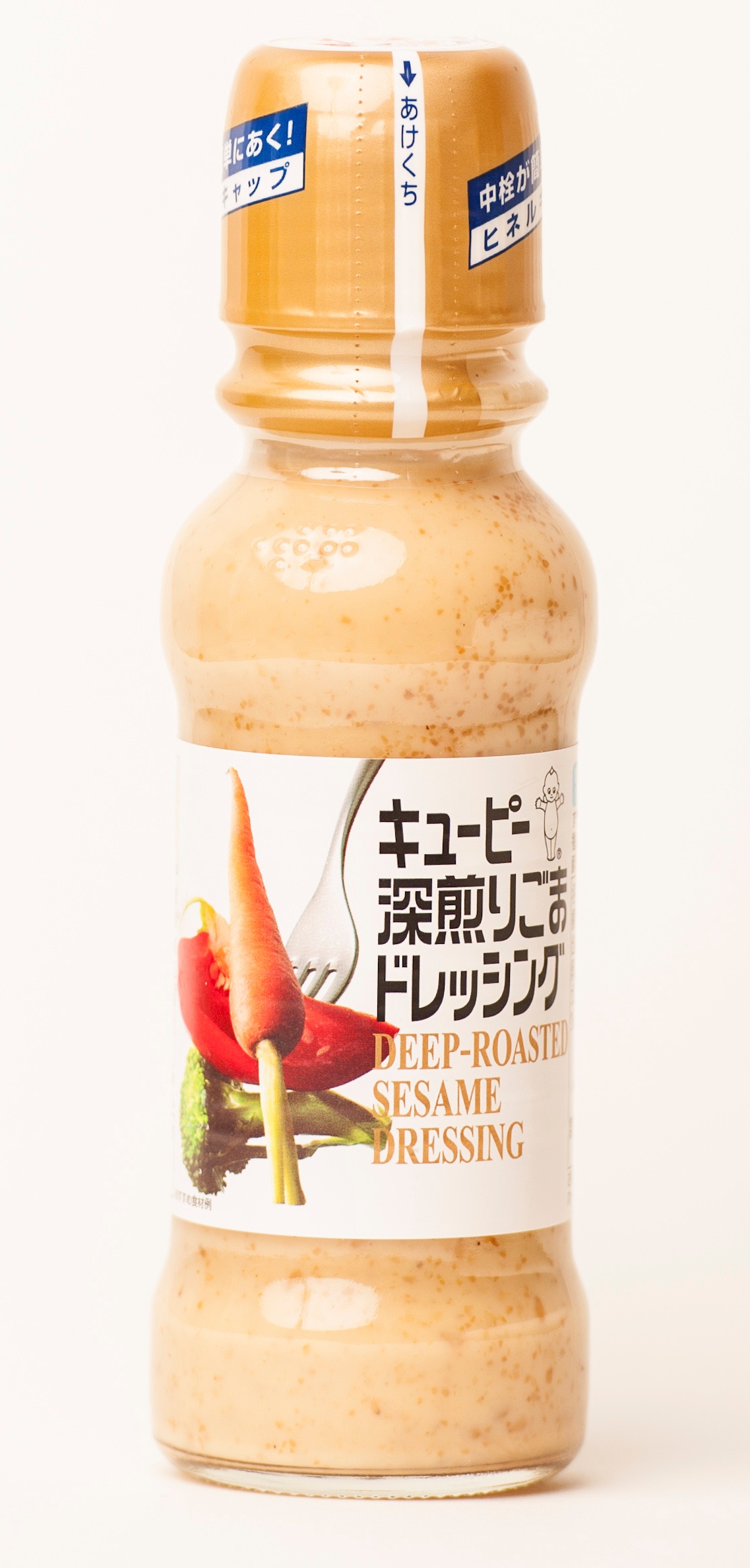
I know that when I suggest salad dressing in a bottle, many foodies will roll their eyes. But before you turn your back on me, you need to know that Kewpie Deep Roasted Sesame Dressing is something special. Like many of you, I make my salad dressing with fresh, good-quality ingredients. I go to olive oil and vinegar tastings every year before selecting a region or brand that I’ll use on my salads.
The first time I tried Kewpie Deep Roasted Sesame Dressing was at Emmy and Ben’s dinner party in Taipei. It took one bite of salad for me to notice the dressing’s rich sesame flavor, a savory burst with a hint of natural sweetness, all incredibly light. I asked Emmy how she made her dressing and expected to hear a long list of ingredients and some advanced culinary techniques (which my friend certainly possesses). To my surprise, Emmy went into her kitchen and returned with a ready-made bottle. I tasted the salad dressing by itself and it was unique and delicious.
One Dressing, Multiple Dishes
This dressing’s flavorful sesame taste reminds me of the sesame noodles and dumplings I often eat at Chinese restaurants. So I decided to experiment with Kewpie Deep Roasted Sesame Dressing by adding it to different foods: noodles, dumplings, tofu and coleslaws. I used it as a sauce for noodles (pasta), a dipping sauce for pan-fried tofu, mushrooms, fish and meat, and I marinated coleslaw and cold tofu with it. Everything turned out delicious—this is a truly versatile dressing.
Here’s one simple yet tasty recipe that takes only 3 minutes to prepare.
Sesame Dressing with Noodles
Ingredients for 1 Serving:
Instructions: (Total Cooking Time: 3 minutes)
You can eat these noodles hot, at room temperature or cold. It’s perfect for parties and picnics because you can make the dish in advance and leave it in the refrigerator.
Try Kewpie Deep Roasted Sesame Dressing with different dishes. And please share your recipes with us. If it’s good, I’d love to post your culinary creation for everybody’s enjoyment.
What Is So Special About Asian Diet?
My friends often ask me why Asian people look so much younger than our age. The truth is, Asian or non-Asian, the three keys to staying young and healthy are diet, exercise, and good sleep. Asians don’t necessarily exercise more or sleep better than other people, but what we eat is often unique. For many Asians, food is not only a source of nutrition, but the first defense against preventing illness. When we have a cold or feel chilled, we drink hot ginger water. We eat watermelon to get rid of canker sores and pimples. To increase qi (internal energy flow), we eat ginseng. In fact, we eat different foods during different seasons for the betterment of our health, especially during seasonal changes when our bodies are more prone to illness. It’s not just good food that equates with good health; we should eat the right food at the right time to maintain a strong, vibrant body.
 The Next Fountain of Youth
Growing up in Asia, I became familiar with a long list of healing foods and supplements: tea, ginseng, reishi, fo-ti, longan, and red yeast rice. But when I think back to the one healing food that seemed most common, goji berries (also called wolfberries) took the gold. Here’s my earliest goji berry memory from when I was four years old. Because my mother was an entrepreneur and running a business, she hired a cook to make sure her kids had food on the table. Soup was served as one of the five courses every day and during one dinner, I saw many beautiful orange ovals floating on top of the soup. I asked my mother what they were and she told me, “That’s goji and it’s good for your eyes.” Up until that point, the only good food I knew was “Popeye’s vegie,” which is what I called spinach in my four-year-old days—I was a big fan of the cartoon and firmly believed spinach would make me grow as strong as the sailor man. I remember fishing out the goji berries with my spoon so I could taste them on their own. I quickly fell in love with the taste and texture of this magic food. Back then, I didn’t know goji berries were the next fountain of youth and that Asians had been eating these berries for generations to look younger and live longer. What I did know, immediately, was that I liked goji berries so much more than spinach.
What is a Goji Berry? 
The goji berry is a bright red-orange fruit, which originally grew in China. The fruit belongs to the Nightshade Family, a family of agricultural crops with medicinal value. The berries are usually dried (think sun-dried tomatoes) and are a little smaller than raisins.
The Health Benefits of Goji Berries
Goji berries are packed with vitamin A, C, B1 and B2, calcium, iron, zinc, potassium, and selenium, along with five unsaturated fatty acids and antioxidant properties. As we know, antioxidants slow the aging process, boost the immune system, and lower cholesterol. Like most berries, goji berries contain compounds that can prevent cancer and heart disease. In fact, according to Chinese medicine books, which are thousands of years old (compare that with the FDA, which was founded in 1906!) there are seventeen different health benefits connected to goji berries, not the least of which, as my Mom pointed out, is improved vision.
 How to cook
Goji berries are affordable and versatile. Ten dollars will get you a half pound of top-grade goji berries, but most recipes call for a few spoonfuls. They are all natural, non-toxic and can be used daily. If you are making goji berries a part of your daily diet, 20 grams a day is the right amount. When used medicinally, 30 grams is appropriate. Gojis can be added to beverages and soups, to stews and congees, to cereals and oatmeal, and even to cookies cakes and other desserts. They can be boiled, steamed or stir-friend. Or simply rinse them and treat them as a condiment to almost any food. One simple way to cook goji berries is to add one tablespoon of berries to a cup of water and boil. Fifteen minutes later, the semi-sweet goji berry beverage is done. Drink it hot or cold and you’ll start feeling young in no time.
Just Like Your First Love 
Cherry tomatoes stuffed with marinated plums, one of the most beloved finger foods in Taiwan, are sold at every night market and outside most movie theaters. Sweet, savory, tart and juicy, this bite-size hors d’oeuvre is packed with flavors waiting to explode in your mouth. Remember your first love? It was juicy, fresh like the first spring day, incredibly sweet, yet tart (with uncertainty) and salty (like tears). The combination of cherry tomatoes and marinated plums tastes much like the many layers of a first romance, without the unwanted bitterness, of course.
How to Prepare
The best thing about preparing cherry tomatoes stuffed with marinated plums is that no cooking is required. You simply cut the cherry tomato half way to create a pocket, insert a small piece of marinated plum and your job is done. Since the plum is often as big as the cherry tomato, I usually cut the plum into two or three pieces. (A good-sized marinated plum is big enough for three cherry tomatoes.) You can eat this snack at room temperature or refrigerate it for a couple of hours (or even overnight) and enjoy it chilled. Plum-stuffed cherry tomatoes also make a great hors d’oeuvre for parties since you can prepare them in advance, take them from the fridge and serve. And marinated plums are a great everyday snack, a definite healthy alternative to potato chips or cookies.
 The History of Marinated Plums and How They Are Made
The Chinese first discovered marinated plums by accident in the Warring State Period (403 BC – 221 BC). Legend has it that an imperial maid found a plum, which had fallen from a plum tree into a beehive. The maid bit into the honey-marinated plum and found it sweet, tart and thirst-quenching. She then picked more plums and marinated them with honey and salt. Still, the Chinese didn’t mass produce marinated plums until the Han Dynasty (around the second century BC). Unlike the ancient production method, today’s plums are marinated with salt, licorice and sugar instead of honey.
The Best Brand
The brand I like best is Ego Seedless Plums. Not only are the plums pitted, but each plum is individually wrapped. If you can’t finish the whole box in one sitting, the plums won’t go to waste. Also, the individual package makes it easy to carry when you’re on the go.

Wood vs. Stainless Steel: A Utensil Comparison 
Did you ever notice a metallic taste when eating with a stainless-steel fork or spoon? This metal taste is usually subtle, but it becomes obvious when you eat acidic fruit, salad with lemon dressing, or delicate food. When I told a group of friends about my finding, many were skeptical. As the saying goes, the proof is in the pudding, but since I don’t make pudding, I opted for a tuna avocado salad with lemon dressing. I prepared the salad, set it down on the table and handed out wooden forks and metal forks. Sure enough, with a side-by-side comparison, even my most skeptical friends tasted a silent metal favor in the creaminess of the avocado marinated in lemon dressing. With wooden forks, the salad tasted pure. Indeed, the metal utensils changed the flavor of an acidic salad. While we finished lunch, we wondered aloud about how many people actually taste a metal flavor when using stainless-steel utensils. A quick search online brought us to a Facebook page dedicated to this exact issue: “I hate when my spoon or fork tastes like metal.”
Don’t Kill the Fish Twice
I once saw a man eat sashimi with a fork at a Japanese restaurant. While most people picked up the delicate raw fish with wooden chopsticks, he used metal cutlery. As he speared the toro, I felt as though the blue fin tuna had been killed twice—first by the fisherman and second by the sharp stainless-steel tines. He then dipped the toro into soy sauce and wasabi before finally putting it in his mouth. With the fork stuck through the delicate fish, the taste of the fatty tuna was indelibly altered. I looked around the restaurant and thought, “In a perfect foodie world, the sushi police would miraculously appear, stop the man from forking his toro and then a kind waitress, standing right behind the man, would offer him the perfect alternative—a wooden fork.”
 Not All Wooden Utensils are Created Equal
Perhaps because many Asians grew up eating with wooden utensils, we are more aware of the metal taste; after all, wooden utensils are a lot more popular in the East than the West. Every year I go back to Asia, and each time I find more varieties of wooden forks and spoons, crafted in different lengths and shapes and colors. Finding the perfect wooden spoon or fork is like finding the perfect pair of jeans; it requires time, energy and dedication (but luckily no diet). Many of the wooden forks I found were too flaky and broke after a few uses. And many of the wooden spoons were either too shallow to hold much food or too big to eat comfortably. My favorite wooden spoons and forks measure 7 ¾ inches, just the right length for eating. I especially like the ones with black threads wrapped tightly around the handles; not only are they beautiful, but they also prevent slipping.
Although wooden utensils are generally dishwasher safe, I recommend washing them by hand in order to prolong their lives. Wooden forks and spoons, which guarantee a pure eating experience, belong in everybody’s utensil drawer and make great gifts, even for people who seem to have everything.
A Bite of Spring – Romaine Lettuce
When my friend Emmy visited from Taiwan last year, and the subject turned to food, as it often does with me, I told her, “I miss Ei-a Vegetable but it’s almost impossible to find any in the US.” (For those who’ve never heard of it, Ei-a Vegetable is commonly known as “A” Vegetable. Taiwanese use the English letter “A” to preserve this vegetable’s Taiwanese pronunciation.) Sensing my chagrin, Emmy hit me with this secret, “A Vegetable is a cousin of Romaine Lettuce. You can just use Romaine for stir-fry.” Suddenly I saw lettuce in a whole new light. Continue reading
Adam’s mom inspired me to write this blog entry. When Adam brought her a wok from Taiwan, she wasn’t sure what to do. Growing up in Asia, cooking with a wok was second nature to me, so this week’s post is all about de-mystifying the wok.
Why Not Wok-n-Roll?
Many of my American friends think woks are only good for stir fry. And if they never learned Chinese cooking, they avoid woks like I avoid operating heavy machinery. While a wok tends to be big and bulky, and almost never comes with instructions, it’s potentially the most versatile cooking vessel in your kitchen. Personally I don’t buy any oversize kitchenware if it performs only one function, especially because I live in a small Manhattan apartment. (I pay $50 a month for my refrigerator space alone.) So everything in my tiny kitchen is multifunctional. If you already own a wok or are thinking of buying one, you should know that woks are about much more than stir fry. Here are some of the many ways I use my trusty wok.
Top 10 Ways to Use a Wok:
1. Tossing Salad
The standard wok for home use is 12 to 14 inches wide and 4 to 5 inches deep. It’s the biggest salad bowl in your kitchen. Put your vegetables in, toss them and serve.


Mugi Bakery & Cafe in Flushing, New York
You probably remember the last time you ate at a Chinese restaurant or had Chinese takeout, but when was the last time you went to a Chinese bakery? If the answer is never, you’re missing out. Asian people go to Chinatown, Koreatown, Little Tokyo and Little Manila in North America and Europe, not just to eat or shop, but also to visit their bakeries. Most Asian countries have their own style of bakeries, but Chinese bakeries outnumber all the others. In New York City alone, there are more than 120 Chinese bakeries. In Toronto there are a whopping 160. And the numbers are growing fast. In fact, Chinese bakeries are going mainstream, spreading beyond the borders of Chinatowns. Now you can find them at Citi Field, in Manhattan’s Garment District, and near UC Irvine’s campus. Continue reading

When I was little, there were several “Western-style” (西點麵包) bakeries in Taipei. They baked hot, soft, savory-sweet bread and sold cold milk that came in glass bottles. Eating those Western-influenced baked goods was my earliest and most delicious food memory, and the experience was so profound that I often dream about it now, many years and many miles later. Just last week, when I passed by a bakery on Madison Avenue, the aroma took me directly back to my childhood.
When I was three, my family lived on Zhongshan North Road, Section 2, an eight-lane thoroughfare that was also the most high-end district in Taipei. Back then, Zhongshan North Road was Taipei’s equivalent of Fifth Avenue in NYC with its deluxe hotels, five-star restaurants, airline headquarters, premium boutiques, English bookstores and throngs of tourists. It was actually more stunning than Fifth Avenue because majestic maple trees lined the wide road for miles.
My eight-year-old sister, Wen-wen, would come home from school at three o’clock every day, too late for lunch and too early for dinner. Wen-wen and I always got hungry at this odd hour so my mother, a successful businesswoman, would give my sister money to take me to a “Western-style” bakery. It was actually the perfect time to go to a bakery because the bread was baked twice a day, early in the morning and in mid-afternoon. If you go to a bakery in Taiwan during these times, you’re sure to have hot, soft, steaming buns. Back then, bakeries were not as popular as they are in Taipei today, so we had to walk 10-15 minutes to reach the closest one. During our walk, my sister usually asked me what kind of bread and milk I would choose. The milk was either white or flavored with juice; chocolate milk came later. Although there were more than a dozen varieties of bread, I usually chose between my four favorites: Scallion Bun, Pineapple Bun, Peanut Butter Bun or Strawberry Jam Bun. I took our food discussions seriously, perhaps because this was the only time I was in charge of choosing my own food. I’d tell Wen-wen exactly what I was going to eat and why—I always had a very specific explanation for my daily snack! My sister would listen patiently and then, copying my chain of reasoning, she’d tell me her bakery choices for the day.
Wen-wen and I usually sat side-by-side facing the window and ate our snacks quietly. Silence is the only sound when the food speaks louder than the world. I liked to watch the people walk by through the big glass window. Sitting on a stool, legs too short to touch the floor, I held a bun in one hand and a bottle of milk in the other. (How I miss those days when milk came in a glass bottle—an age of simple and clean food.) The bread was hot, the aroma of baking surrounded the whole store and lingered blocks away, and I savored every bite of my bread as if it were the last food I’d ever eat. My family always teased me about my intense concentration when I ate. The outside world disappeared. I truly lived for the moment, for every bite of food I had in my mouth. This bakery ritual lasted until I started elementary school, but my sister and I never grew tired of our afternoon strolls.
I still remember vividly one afternoon when my sister and I were walking home from a bakery and I looked up at Wen-wen as she told me her school stories. I saw the sunshine sparkling through the maple tree leaves, enjoyed the fall’s lazy breeze brushing by my face, and felt full, content and loved. I was only three or maybe four but, young as I was, I knew at that very moment I was blessed—blessed to be walking on beautiful Zhongshan North Road with delicious buns in my stomach and my loving sister by my side.
Perhaps it’s because my bakery memory was so profoundly satisfying, or perhaps it’s because my sister Wen-wen departed this world at the young age of 29 (and not a day goes by that I don’t miss her), but I keep dreaming about walking into my favorite childhood bakery and choosing hot bread. Living in New York City for the past fourteen years, the bakery has become the passage back to my childhood and to my homeland, Taiwan.
In my next post, I will talk about the rise of the Chinese bakery in North America and Europe. I will also discuss what distinguishes a Chinese bakery and describe some of the delicious goods they bake.
 My Experiment With Oatmeal
I first thought of making oatmeal for breakfast because of its health benefits – full of fiber, vitamins, and antioxidants, oatmeal can lower LDL (bad cholesterol) and even reduce weight. Knowing virtually nothing about this hot cereal except for its benefits, I did some research on different types of oatmeal and their tastes. My first bite of unflavored oatmeal left me less than impressed. Americans in the mid-1800s called oatmeal “nothing more than horse feed” and I suddenly felt sorry for the horses. Still, I thought, oatmeal has to be good for you. Anything that tastes this bland, but has been around for this long, must be healthy. Otherwise oatmeal would be extinct with the dinosaurs. Continue reading
 Asia by Frida